Design Process
Personal Perspective
While working on this project, I focused on understanding the real challenges families face when visiting museums. I observed that parents often spend more time managing logistics than enjoying the experience with their children. This insight guided my design decisions, pushing me to create a solution that reduces stress and supports families at every stage of the visit.Designing for children of different age groups challenged me to think beyond standard interfaces and focus on accessibility, simplicity, and emotional comfort.
User Research & Personas
Drawing on over ten years of experience in museum educational departments, I collected insights through direct observation of families visiting museums as well as a school and preschool groups. This deep understanding of visitor behavior allowed me to identify real needs, preferences, and pain points for parents , children and educators.
Design Process & Service Design Approach
I approached this project through a service design lens, focusing on the complete museum experience rather than isolated screens. The journey was structured to ensuring a coherent and continuous experience across all touch-points.
-
I applied service journey mapping to identify user needs, and services offered by museum
-
I used touch-point mapping to group museum services that visitor might need before arriving to the museum facilities, in the museum, and post-visit engagement
wireframes and interactive prototypes to validate layout, usability, and content hierarchy
Integrated usability and accessibility principles to minimize cognitive load for parents and support children of different ages
-
wireframes and interactive prototypes to validate layout, usability, and content hierarchy
-
Integrated usability and accessibility principles to minimize cognitive load for parents and support children of different ages
The Solution
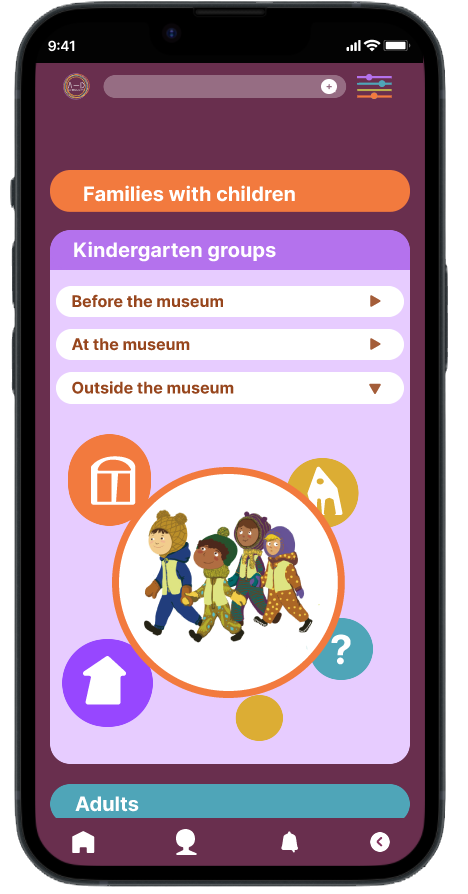
The app experience is divided into three main stages:
-
Before the Museum Visit
Visit planning and preparation
Personalized recommendations based on children’s ages
Suggested routes, activities, and highlights
-
At the Museum
Easy access to museum services
Interactive activities and guidance for children
Clear navigation and real-time suggestions
-
After the Museum Visit
Follow-up activities and educational content
Experience summaries and recommendations
Suggestions for future visits



Outcome
This project strengthened my belief that good UX design is not just about usability, but about empathy and creating meaningful experiences for people. The theoretical solution applied and illustrated in this application prototype can be tested and in a real live situation.
Reflection, ideation, and visualization on how museum services can be structured based on the same concept as described above as an example of potential service development.

